

Dear Friends,
Yesterday, Thursday January 22nd, alongside many UBC students, community members and United Church members and ministers, I stood in solidarity with survivors of Indian Residential Schools, Day Schools, Indian Hospitals and the Sixties Scoop. This show of solidarity was organized by an autonomous collective of Indigenous and ally students at UBC. We gathered outside the Indian Residential School History and Dialogue Centre to oppose the visit of residential school denialists. These denialists are on what they have described as a tour of BC universities. Their tour is meant to incite escalation and debate to capture on film as part of a documentary about “free speech.” Yesterday, the organizers were steadfast and successfully prevented the denialists and their hired security from getting near the Dialogue Centre or the Sacred Garden, and from the center of the crowd where Indigenous dancers and drummers were holding the space. This was not an easy task; the denialists and their hired security were violent and assaulted numerous students, the head of campus security, and those on the front lines opposing them. Despite the violence they brought, the focus should be on the survivors; student organizers were clear that this was not a counter protest, because their denialist claims are based only in hatred. This was a show of solidarity.
When I was in middle school, in Ontario, I was involved in the United Church through youth conferences. At my first Niagara Youth Festival, I participated in the Kairos blanket exercise. Although I had learned about Residential Schools, this was the first time I viscerally understood my responsibility as a settler and a member of the United Church. Later, I attended the 2018 National gathering of DUCC (Diakonia of the United Church of Canada) in Winnipeg where I signed up for a workshop to visit the National Centre for Truth and Reconciliation. We were shown the specific archives and oral testimonies shared by survivors of Residential Schools operated by the United Church. We were also shown the Bentwood Box, which was brought across Canada during the Truth and Reconciliation Commission to hold personal items from survivors. The TRC Commission wrote that, “people placed personal items into the box to symbolize their journey toward healing and expressions of reconciliation.”
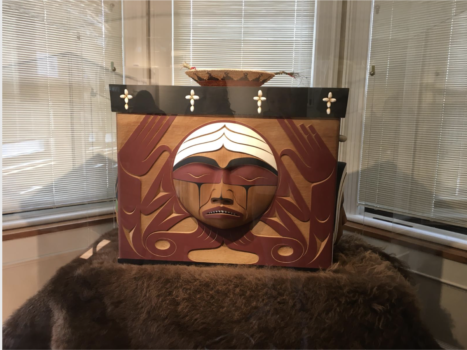
As I stood outside the Indian Residential School History and Dialogue Centre, where stories and belongings are held, surrounded by hundreds in solidarity, I was brought back to the Bentwood Box. I was reminded of how many survivors, and Indigenous folks have carried the weight of healing and of reconciliation. I was also reminded, by the presence of our ministers and members, that our largely settler church continues to put reconciliation and decolonization into action alongside acknowledging the truth of our culpability.
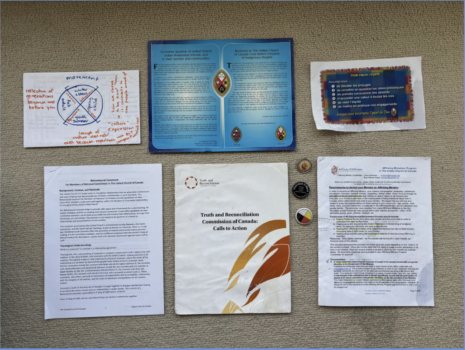
I have a file folder that I carry with me to every United Church meeting. In it are some of the following: a well-travelled copy of the Truth and Reconciliation Commission of Canada: Calls to Action from the center in Winnipeg, a blue copy of the 1996 Apology and 1988 Response which I received at GC43, my notes from a Four Directions decision making training workshop, and a heavily annotated copy of the requirements to become an Affirming Church from 2016. We have made a plethora of commitments in words and in covenant. Our world and our church are hurting, and we have a responsibility to show up in the ways that Jesus calls us to. I am proud to carry our commitments in words in a file folder, but more importantly, I am called to stand alongside this community, with PMRC staff, ministers and congregation members to physically show up in solidarity.
This church is the place I have learned the most about reconciliation, not because we have completed our commitments but because communities consistently show up to learn how to enact them with humility. I am proud to be in community with people who are working to reconcile past and ongoing harms, to listen, and to give what they can for justice. My prayers are with the Survivors and their families who have witnessed this hateful denialism, and I share prayers of strength and humility for all of us working together for reconciliation and decolonization.
In Solidarity,
Thea Sheridan-Jonah (she/her)
Executive Council President Elect
Pacific Mountain Region
Writing on Unceded Musqueam, Squamish, and Tsleil-Waututh Territory